


 English
 中文简体


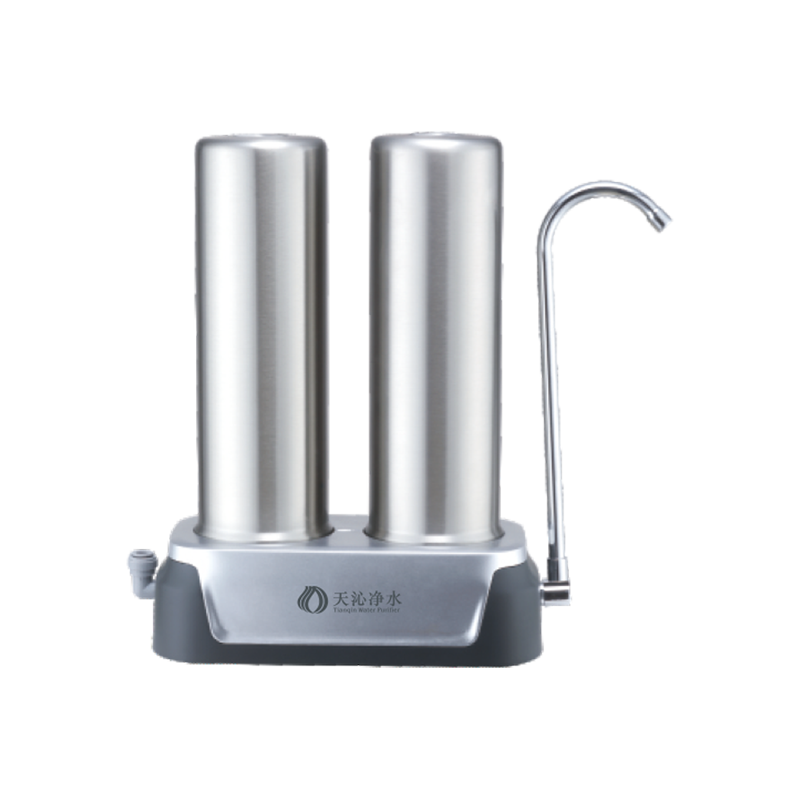


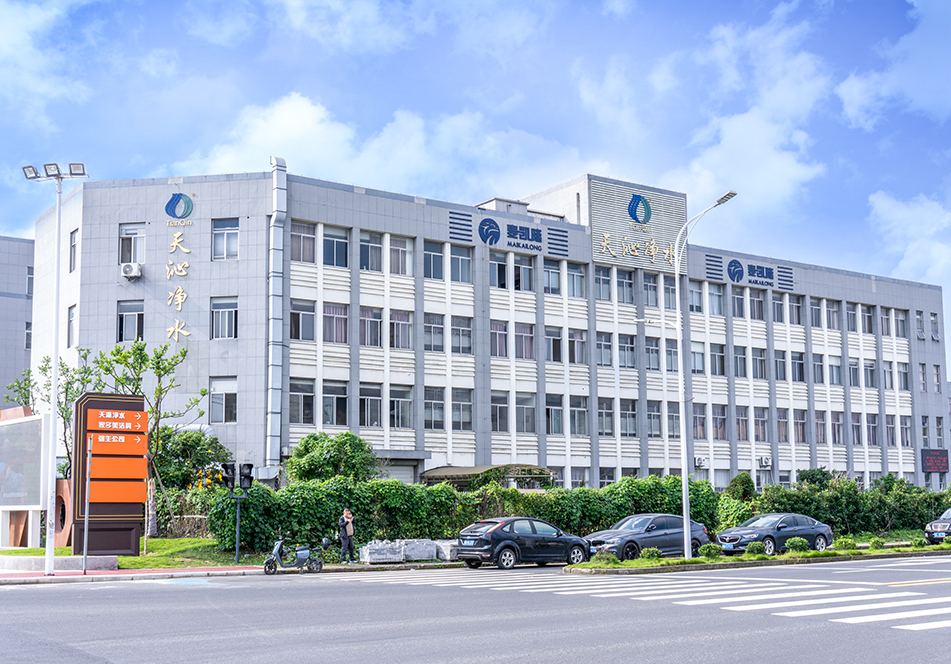
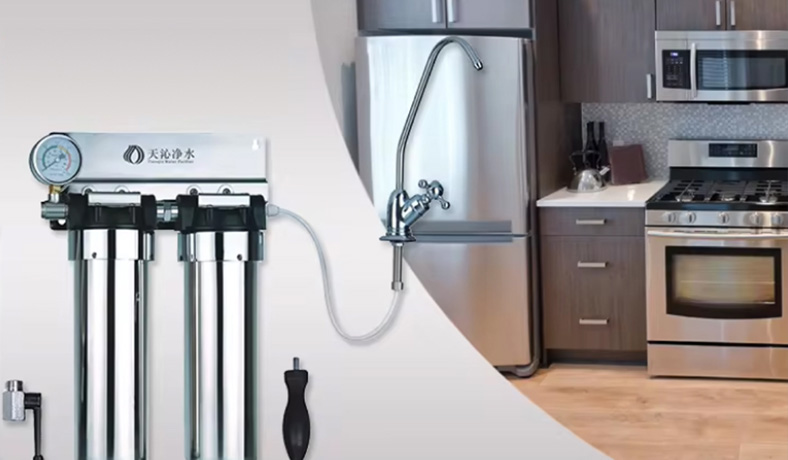

Yuyao Tianqin Water Purification Equipment Co., Ltd. has produced stainless steel household water purification equipment since 1998, and the Stainless Steel Desktop Water Purifier manufacturer line is the compact end of that programme. These are counter-top units built around a 304 stainless steel body, a standard 10-inch filter stack and 1/4-inch quick-connect plumbing, supplied to distributors, water-treatment contractors and OEM buyers for kitchens, offices, clinics, tea rooms and small food-service counters.
We manufacture in Yuyao, Zhejiang, in a 30,000 m² facility, with a current desktop range of four configurations and a typical production lead time of around 15 days. Units are exported to the Middle East, Southeast Asia, Europe and other markets where a durable, serviceable purifier is needed without a dedicated utility room.
Why Our Desktop Purifiers Use 304 Stainless Steel
The housing is the part a customer touches every day and the part that determines how long the unit looks and performs like new. We use 304 stainless steel for the body because it resists corrosion and wear in damp kitchen and pantry conditions, does not deform under normal handling, and presents a smooth, non-porous surface that is easy to wipe down and does not harbour the bacterial film that can form on scratched plastics.
- Corrosion and wear resistance for long service life in humid interiors.
- Smooth internal and external surfaces that limit secondary contamination and simplify sanitation.
- Rigid body that holds the 10-inch cartridge stack square, keeping seals seated under line pressure.
- Counter-top footprint that frees floor space and allows relocation without replumbing a plant room.
Filtration Architecture Across the Range
Desktop purifiers work as a staged train rather than a single cartridge. The arrangement is selected by feedwater quality and by the taste and mineral profile the market expects, and it can be adjusted per order within the same 10-inch housing format.
- Primary layer — retains silt, rust and suspended solids before they reach the membrane, extending downstream cartridge life.
- Ultrafiltration membrane — micron-level pore size intercepts bacteria, colloids and macromolecular organics while allowing dissolved minerals and trace elements to pass.
- Granular and block carbon (GAC / CTO) — adsorbs residual chlorine, odour, colour and part of the dissolved organic load.
- Ceramic candle — an optional turbidity barrier for feedwater with visible sediment or seasonal spikes.
- Post-carbon polish and CRM stage — final taste correction on models configured with a finishing cartridge.
Where a project requires full dissolved-solids reduction rather than mineral retention, we normally pair the desktop unit with a reverse osmosis water purifier or route the feed through a stainless steel pre-filter first; the desktop unit then serves point-of-use drinking and beverage preparation.
Our Stainless Steel Desktop Water Purifier Range
C1-1 High Efficiency Dechlorination
Carbon-forward train for municipal supply with noticeable chlorine. Reduces residual chlorine, odour and colour for offices, tea rooms and catering counters.
F2 G2 High Pressure Resistant
Reinforced body and connections for direct mains feed, high-rise plumbing and pump-fed lines where pressure surges are routine.
C1 Easy To Install
Quick-connect layout and easy-change cartridges for retrofit projects, distributor kits and rental or hospitality fleets.
High Magnet
Ceramic candle / PP / CTO / UF / GAC / CRM stack with a magnetic stage, listed at 150 L/h, for turbid or variable feedwater.
| Model | Filtration emphasis | Typical application fit | Configuration notes |
|---|---|---|---|
| C1-1 | Dechlorination, carbon-forward | Municipal mains with chlorine taste; offices, tea points | UF stage retains minerals; 1/4" connector |
| F2 G2 | Pressure resistance and mechanical strength | High-rise buildings, direct mains, booster-fed lines | Suits unstable or elevated feed pressure |
| C1 | Fast installation, easy cartridge change | Retrofit projects, distributor kits, rental units | Standard 10" stack, tool-light servicing |
| High Magnet | Multi-stage with ceramic pre-layer and magnetic stage | Turbid or variable feedwater; mineral-retention drinking water | Ceramic candle/PP/CTO/UF/GAC/CRM; 150 L/h listed |
Critical Specifications and Configuration Choices
Every desktop order is built to a written configuration: body material and finish, cartridge sequence, connector size, dispensing function and packing count. The parameters below define what a unit will and will not do in service.
- Body: 304 stainless steel, smooth finish, corrosion and wear resistant.
- Cartridge standard: 10-inch housings; sequence varies by model from PP and ceramic through UF and carbon to post-carbon and CRM.
- Ports: 1/4-inch quick connector as the standard inlet and outlet interface.
- Listed flow: 150 L/h on the High Magnet configuration; other models are rated against the installed stack.
- Pressure class: standard or high-pressure-resistant variants for surge-prone lines.
- Dispensing: ambient only, or combined hot and cold functions on models configured for beverage use.
- Packing: 10 pieces per carton, carton dimensions 54 × 30 × 40 cm.
Installation, Feed Pressure and Line Integration
Desktop units install on a stable counter within reach of a feed point and, on hot/cold models, a power outlet. Pipework is 1/4-inch tubing run from a tee on the cold supply; a shut-off valve on the feed lets cartridges be changed without isolating the building line.
- Feed pressure below the working range causes short cycling and slow dispensing — a booster pump restores stable flow.
- Feed pressure above the working range requires a pressure-reducing valve upstream, or the F2 G2 body where surges are systemic.
- Flush new carbon cartridges before first draw to clear fines.
- Keep the unit clear of cooktops and direct steam, and leave access space for cartridge removal.
Where a site needs higher volume than a single desktop unit delivers, we size multiple points of use or step up to our ultrafiltration water purifier range and treat the desktop units as dispensing points.
Quality Control, Compliance and Acceptance
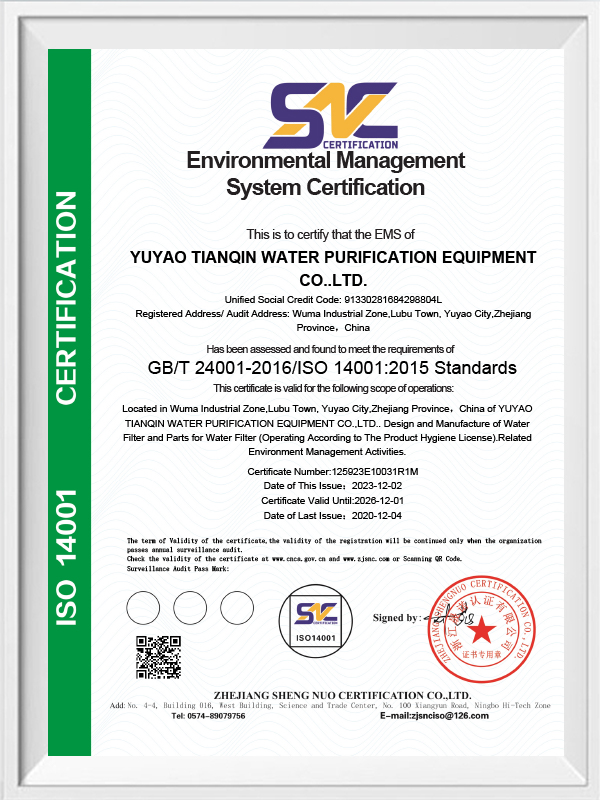
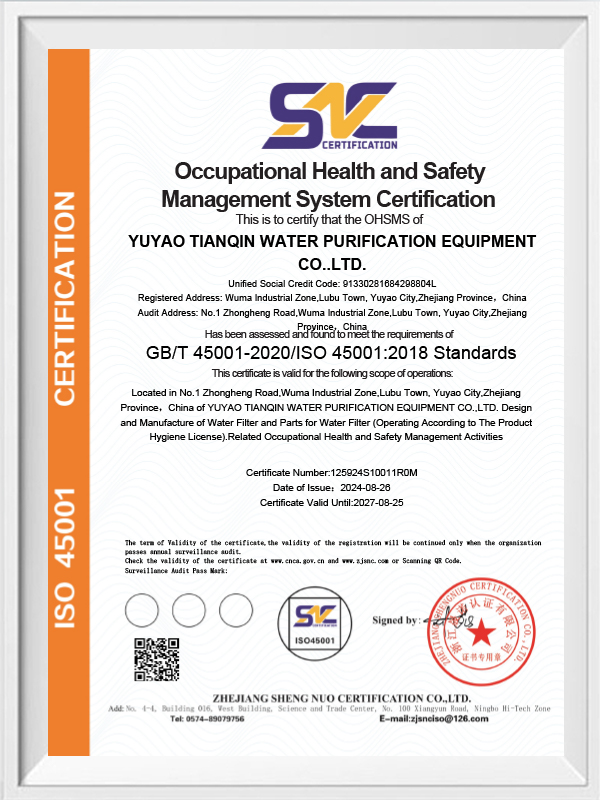
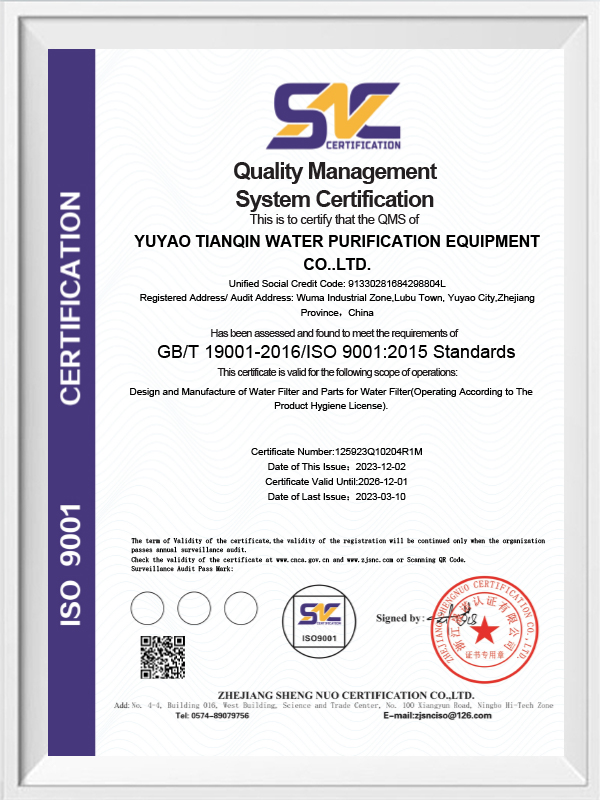
Our quality system is certified to ISO9001, and we hold environmental management and occupational health and safety management system certification. We also hold health licence approval from the Ministry of Health of the People's Republic of China and are a member of the American Water Quality Association.
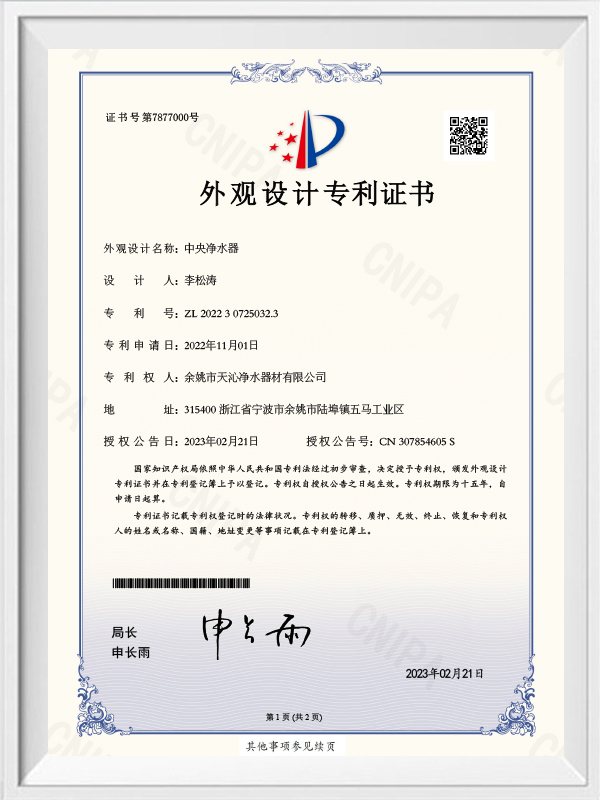
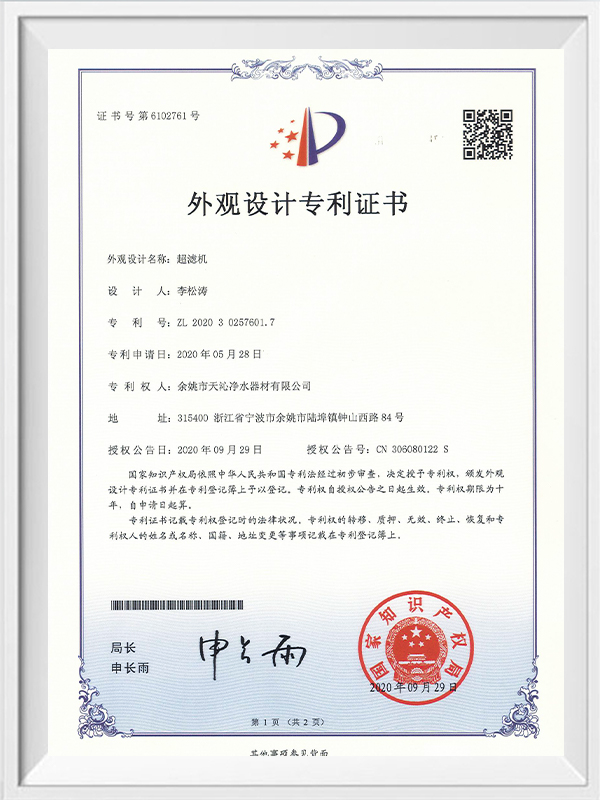
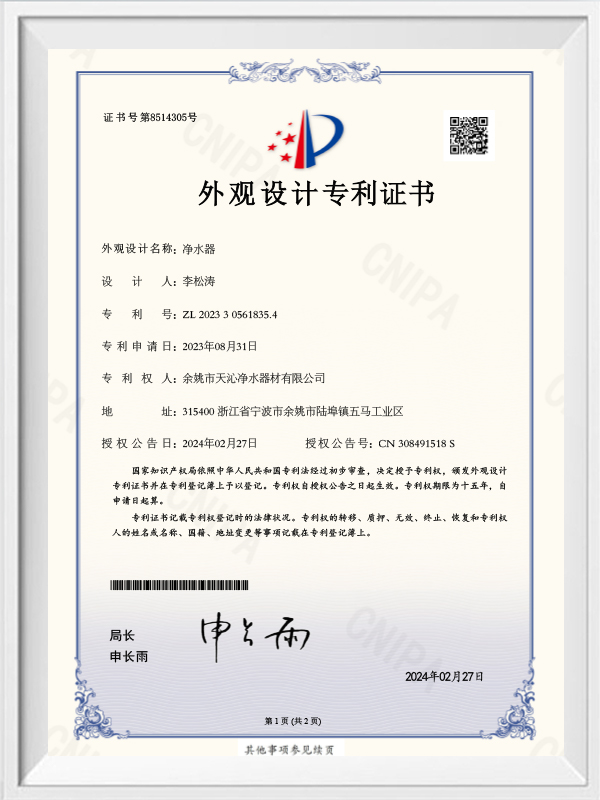
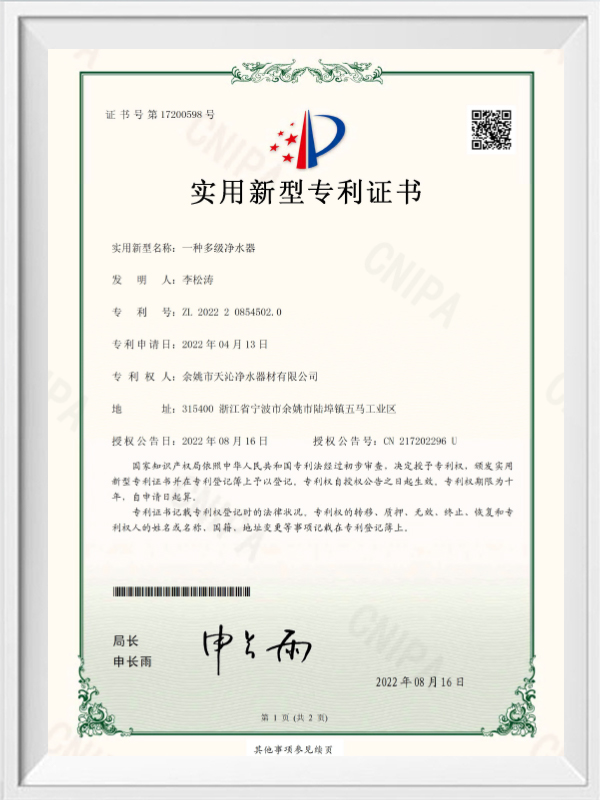
We hold more than ten national patents, including a utility model for a multi-stage water purifier, and we are one of the enterprises that took part in formulating the industry standard for ultrafiltration membrane water purifiers for household and similar uses. Order acceptance is documented against the approved configuration — body material and finish, cartridge sequence, connector size, pressure class, dispensing function, label artwork and carton count — so the goods received match the goods specified.
Filter Replacement, Spare Parts and Serviceability
Service life is set by the feedwater, not by the calendar alone. High turbidity loads the ceramic or PP stage quickly, and high residual chlorine exhausts carbon ahead of schedule, so replacement intervals are written against the site's water analysis.
- Easy-change cartridge system; no specialist tools required for routine swaps.
- Ceramic candles can be cleaned and returned to service where the coating is not worn through.
- Housing seals, connectors and cartridge sets are supplied as service items.
- Heating and cooling models should be descaled on the schedule set by local water hardness.
Information We Use to Configure Your Solution
| Project input | What we need | Why it changes the build |
|---|---|---|
| Feed source | Municipal, well, tank or mixed supply | Sets the pre-stage and carbon loading |
| Pressure data | Minimum and maximum feed pressure, surge history | Points to the pressure-resistant body or upstream valves and pumps |
| Water analysis | Turbidity, residual chlorine, hardness, TDS | Selects the cartridge sequence and service interval |
| Demand | Peak litres/hour and daily volume | Confirms model and number of units per site |
| Dispensing | Ambient only, or hot and cold | Defines the electrical configuration |
| Commercial terms | Private label artwork, market documentation, quantity and schedule | Sets packing, labelling and production planning around a typical 15-day lead time |
Frequently Asked Questions
Which feedwater suits a stainless steel desktop water purifier?
Municipal and treated supplies with moderate turbidity and chlorine are the natural fit. For visible sediment or seasonal turbidity, we specify the High Magnet version with a ceramic candle ahead of the PP and carbon stages so the membrane is not loaded with solids.
Which model should be used where mains pressure is high or unstable?
The F2 G2 High Pressure Resistant model is built for that duty, with a reinforced body and connections for direct mains and pump-fed lines. If surges are occasional rather than systemic, a pressure-reducing valve upstream of a standard unit is usually the more economical arrangement.
What filtration sequence does the High Magnet model use?
The High Magnet configuration runs ceramic candle, PP, CTO, UF, GAC and CRM stages, with a listed flow of 150 L/h. The sequence removes sediment, chlorine and microbiological load while leaving dissolved minerals in the drinking water.
Can you supply private-label or custom configurations?
Yes. We develop and produce against customer drawings or samples, and we adjust cartridge sequence, connector size, dispensing function, label artwork and carton printing to the order. A configuration is confirmed in writing before production begins.
How are the units packed and how long does production take?
Desktop units pack 10 pieces per carton at 54 × 30 × 40 cm. Typical lead time is around 15 days, scheduled against the confirmed quantity, cartridge set and packaging requirements.
Does a desktop purifier need a pump or a power supply?
Ambient-only units run on line pressure and need no power; a booster pump is added only where feed pressure falls below the working range. Models with hot and cold dispensing require an electrical supply, and we confirm the voltage and plug standard at order stage.


